

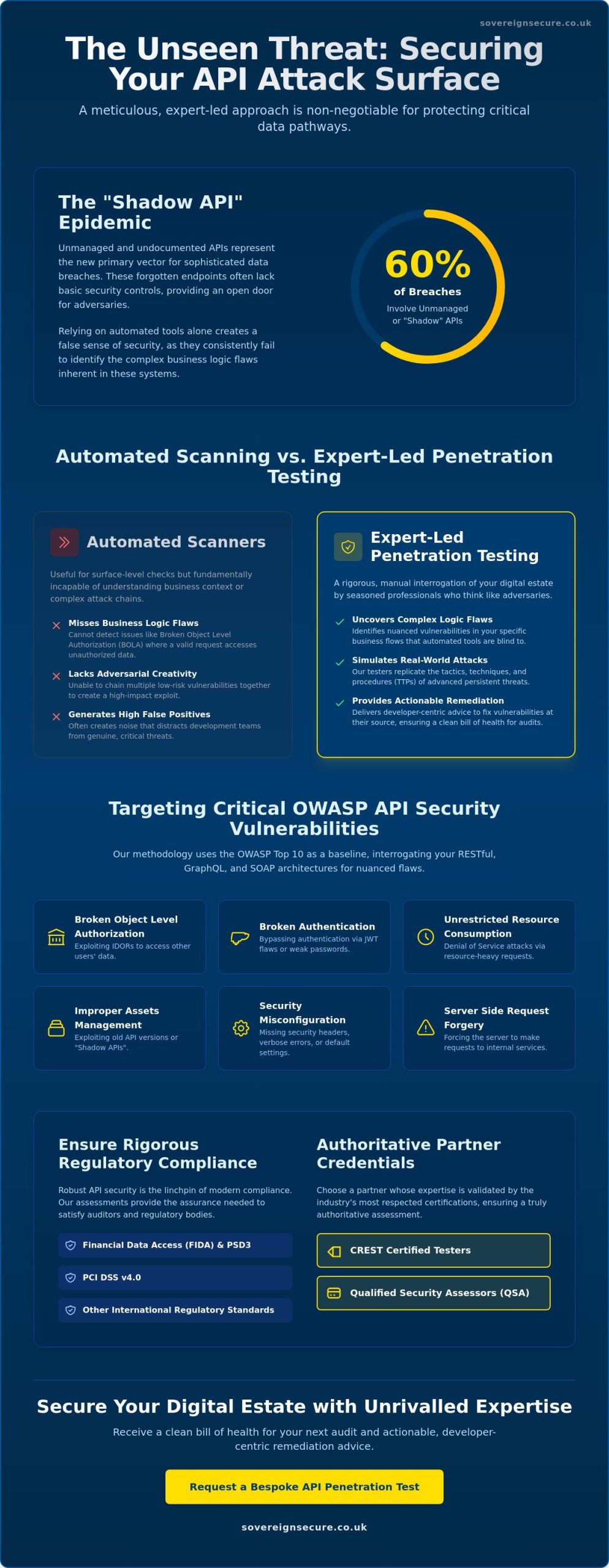
More than 60% of security breaches involve unmanaged or “shadow” APIs, a statistic that reveals the hidden fragility within many modern corporate architectures. For the enterprise that prioritises absolute discretion and technical rigour, relying on automated tools that overlook complex business logic flaws is an unacceptable risk. Securing these vital data pathways requires specialised api penetration testing services designed to uncover the nuanced vulnerabilities that standard scanners simply cannot detect.
It’s natural to feel the pressure of the Financial Data Access (FIDA) framework and PSD3 regulations, both of which were finalised in the first half of 2026. You deserve more than a cursory scan; you require the quiet confidence that comes from a meticulous, manual assessment of your entire digital estate. We promise to deliver a clean bill of health for your regulatory audits along with actionable remediation advice that your developers can implement with precision. This article details how a bespoke methodology addresses the OWASP API Security Top 10 to ensure your third-party data exchanges remain entirely secure.
Key Takeaways
- Understand why modern APIs represent the primary attack surface for sophisticated data breaches and how to identify these critical vulnerabilities.
- Learn how elite api penetration testing services utilise the OWASP API Security Top 10 as a baseline to uncover complex logic flaws that automated tools frequently miss.
- Discover the essential role of API security in maintaining rigorous compliance with PCI DSS v4.0 and other international regulatory standards.
- Identify the necessary credentials, such as CREST and QSA certifications, required to ensure your security partner provides a truly authoritative assessment.
- Explore the value of receiving actionable, developer-centric remediation advice that facilitates a clean bill of health for your next major audit.
What are API Penetration Testing Services and Why are They Critical?
Professional entities recognise that APIs are the silent engine of the modern digital economy. A penetration test focused on these interfaces is a specialised security evaluation designed to identify vulnerabilities before they are exploited by malicious actors. Unlike general assessments, api penetration testing services focus on the unique protocols and data structures that allow different software systems to communicate. This rigour is essential because APIs now represent the primary attack surface for sophisticated data breaches.
In the UK, the fintech and healthcare sectors rely heavily on these interconnected pathways to share sensitive patient records and financial data. With the 2026 implementation of the Financial Data Access (FIDA) framework, the security of these exchanges is no longer just a technical preference. It’s a regulatory mandate. A failure in API security doesn’t just risk a single application; it threatens the integrity of your entire digital backbone and the privacy of every client you serve.
The Evolution of the API Attack Surface
The transition from monolithic architectures to microservices has fundamentally altered the risk profile of the modern enterprise. Cloud-native APIs now handle the majority of internet traffic, yet they remain poorly understood by traditional security measures. This complexity frequently leads to the creation of “shadow APIs.” These are endpoints that exist outside of official documentation and security oversight. Research indicates that more than 60% of security breaches involve these unmanaged APIs, which often lack basic authentication or encryption.
Standard firewalls often fail to provide adequate protection in this environment. They’re designed to inspect packets for known malware signatures, but they lack the context to understand the intent behind an API call. An attacker can use a perfectly valid-looking request to extract thousands of records if the underlying logic is flawed. This is why a specialised approach is required to defend against the 2023 OWASP API Security Top 10 vulnerabilities.
Automated Scanning vs. Expert-Led Testing
Many organisations mistakenly rely on automated vulnerability scanners as their primary line of defence. While these tools are useful for identifying missing patches or outdated libraries, they’re fundamentally incapable of detecting complex business logic flaws. A scanner won’t realise that a user is accessing another person’s private data through a Broken Object Level Authorization (BOLA) vulnerability. It simply sees a successful data request.
Expert-led api penetration testing services involve a seasoned professional who manually interrogates your systems. Our testers think like adversaries, chaining together seemingly minor configuration errors to gain unauthorised access. They look for the subtle inconsistencies that automated tools miss, such as unrestricted access to sensitive business flows or unsafe consumption of third-party APIs. API pentesting is the rigorous manual interrogation of data exchange protocols to ensure unrivalled security.
Our Specialised API Pentesting Methodology
At Sovereign Secure, our approach to security is defined by meticulous planning and a deep understanding of architectural nuance. We don’t subscribe to high-volume, automated models that prioritise speed over substance. Instead, our api penetration testing services employ a bespoke methodology that blends rigorous industry standards with our own proprietary intelligence gathered from high-stakes operations. We use the OWASP API Security Top 10 as a foundational baseline, yet we recognise that for the sophisticated enterprise, this is merely the starting point. Our experts conduct exhaustive interrogations of RESTful, GraphQL, and SOAP architectures to ensure every potential entry point is identified and fortified, ensuring the effective mitigation of sophisticated threats before they can impact your operations.
We pay particular attention to the human element often ignored by competitors. This includes assessing how your APIs might be susceptible to social engineering or the exploitation of stolen credentials via sophisticated phishing campaigns targeting your staff. By simulating advanced persistent threats, we provide an unrivalled level of assurance that safeguards your data integrity and prevents unauthorised access to your most sensitive assets. This holistic approach ensures that no stone is left unturned in your defence strategy. If you require a more comprehensive view of your digital perimeter, our internal penetration testing can complement this API-focused rigour, providing a multi-layered shield for your organisation.
Interrogating Business Logic and Authentication
Business logic flaws are the most elusive vulnerabilities in modern software. Logic is the key. Our api penetration testing services specifically target Broken Object Level Authorisation (BOLA), identified as API1:2023, which remains a primary driver for data breaches. Our testers probe the application logic to see if a user can access another’s data by altering request parameters. We also test for credential stuffing and authentication bypass. By interrogating rate-limiting (API4:2023), we ensure your infrastructure withstands resource exhaustion attempts.
GraphQL and Modern Protocol Testing
GraphQL presents unique security challenges that REST-based scanners cannot comprehend. Precision is our standard. We examine query complexity to prevent denial-of-service attacks that exploit schema flexibility. Our process includes reviewing API documentation, such as Swagger files, to prevent information leakage. We verify that sensitive data transmission uses the latest encryption standards and that data at rest remains inaccessible to unauthorised parties, maintaining the discretion your clients expect.
API Security as the Linchpin of Regulatory Compliance
Regulatory frameworks have evolved to reflect the reality that data no longer resides behind a single static firewall. It’s constantly in motion, flowing through interfaces that must be as secure as the databases they connect. For any organisation handling sensitive financial information, understanding what is the pci dss involves recognising that APIs are the modern gateway to the Cardholder Data Environment. Our api penetration testing services provide the technical evidence required to demonstrate that these gateways are fortified against unauthorised intrusion, ensuring your compliance posture remains beyond reproach.
The transition to PCI DSS v4.0 has made this focus even more critical. The standard now places a significant emphasis on the security of automated data exchanges, treating them with the same level of scrutiny as traditional network endpoints. Beyond payments, the General Data Protection Regulation (GDPR) mandates “Privacy by Design.” This means security cannot be an afterthought. It must be woven into the very fabric of your API architecture. Regular testing ensures that data protection is the default state of your digital ecosystem, rather than a goal you’re perpetually chasing.
Meeting PCI DSS 4.0 Requirements via APIs
Under the v4.0 standard, any API that transmits, processes, or stores cardholder data is considered a functional part of the Cardholder Data Environment (CDE). This inclusion means that regular, expert-led penetration testing isn’t optional; it’s a core requirement for maintaining your certification. Failure to secure these endpoints can lead to significant violations. The table below illustrates how common API vulnerabilities directly correlate with specific PCI DSS requirement failures.
| API Vulnerability (OWASP) | PCI DSS 4.0 Violation | Impact on Compliance |
|---|---|---|
| Broken Object Level Authorisation (BOLA) | Requirement 7: Restrict Access | Critical: Unauthorised access to cardholder data. |
| Unrestricted Resource Consumption | Requirement 1: Network Security | High: Potential for service denial and system instability. |
| Insecure Data Transmission | Requirement 4: Strong Cryptography | Critical: Exposure of sensitive data during transit. |
Supporting Global Standards: ISO 27001 and Cyber Essentials
A robust Information Security Management System (ISMS) requires a continuous cycle of risk assessment and mitigation. Our api penetration testing services act as a vital diagnostic tool within the iso 27001 consultancy process, providing the empirical data needed to satisfy Annex A controls. Similarly, achieving cyber essentials certification in 2026 demands that all internet-facing services, including your APIs, are properly configured and defended against common cyber threats. API pentesting is a mandatory exercise for any entity serious about international security standards.
Choosing the Right API Pentesting Partner: Key Criteria
Selecting a partner for api penetration testing services is a decision that impacts your corporate reputation as much as your technical security. It’s essential to look beyond marketing claims and verify a firm’s standing with international bodies like CREST (the Council of Registered Ethical Security Testers). This accreditation ensures that the professionals handling your data adhere to a strict code of ethics and possess the technical acumen required for high-stakes environments. For those operating within the payment sector, a partner who is also a Qualified Security Assessor (QSA) provides the necessary authority to ensure your testing meets the precise requirements of the PCI Security Standards Council.
We advocate for a “grey box” approach to every engagement. While some providers suggest that “black box” testing is more realistic, it often results in a surface-level scan that misses internal logic flaws. By providing our team with your API documentation, such as Swagger or Postman collections, you allow us to conduct a much more thorough interrogation of your data handling protocols. This transparency ensures that the final report is not merely a list of generic vulnerabilities but a bespoke roadmap for remediation. You can request a consultation for our bespoke security assessments to see how this level of detail transforms your security posture.
The Value of Discretion and Professionalism
The reputation of your security partner is a direct reflection of your own corporate integrity. It’s not enough to find bugs; the firm must handle your sensitive architectural data with absolute discretion. We ensure that every piece of information shared during the engagement is protected by the same level of rigour we apply to our testing. Clear, professional communication between the security team and your internal developers is vital. It prevents the friction that often arises when security is viewed as an obstacle rather than a facilitator of business continuity. Our teams prioritise a respectful distance that reinforces professional integrity throughout the process.
Remediation Support and Re-testing
A penetration test is only as valuable as the subsequent fix validation. Generic lists of vulnerabilities often leave developers confused about the actual risk or the best path forward. We provide actionable remediation advice that speaks the language of your engineering team, ensuring that mitigation is both effective and efficient. This includes dedicated support during the remediation phase to clarify findings and offer guidance on complex logic patches. Once the fixes are implemented, a formal re-test is mandatory to ensure that vulnerabilities have been effectively mitigated and that no new issues were introduced during the process.
Sovereign Secure: Unrivalled API Penetration Testing
Sovereignty implies a standard of independent, high-tier authority that few in the security industry can genuinely claim. We provide api penetration testing services that transcend the common shift toward high-volume, automated platforms, opting instead for a methodology rooted in technical excellence and absolute discretion. Our status as a Qualified Security Assessor (QSA) ensures that our technical rigour is matched by an intimate understanding of the international compliance landscape. This dual expertise allows us to serve as a silent guardian for your digital estate, offering a level of precision that is second to none.
Our reach is truly global. With specialised teams positioned across the UK, USA, and the Middle East, we possess the cultural and regulatory insight required to protect multinational corporate entities and high-net-worth individuals. We understand that security isn’t a regional concern but a global necessity. Every engagement is treated with the same meticulous planning and understated sophistication, ensuring that your most sensitive data pathways remain fortified against increasingly sophisticated international threats. We don’t just find vulnerabilities; we provide the steady hand required to navigate a complex and often hostile digital world.
Our Bespoke Engagement Process
The journey begins with a comprehensive scoping phase, where we align our technical objectives with your specific business requirements. We don’t believe in disruptive testing that hinders productivity. Instead, we tailor our testing windows to ensure your operations continue without interruption, maintaining the seamless flow of your business. Our holistic approach combines deep technical interrogation with strategic advisory, moving beyond simple bug hunting to provide a narrative of safety through structured information. From the initial architecture review to the final executive debrief, every step is deliberate, weighty, and designed to provide a comprehensive view of your security posture.
Secure Your Future with Sovereign Secure
Achieving a Sovereign-certified infrastructure provides more than just a clean audit report for your next regulatory deadline. It offers the peace of mind that comes from knowing your digital backbone has been interrogated by an elite team of competent professionals who prioritise your privacy above all else. We invite you to discuss your specific architectural challenges and security requirements with one of our consultants, who can provide a tailored perspective on your needs. Secure your digital legacy and ensure the integrity of your third-party data exchanges with the steady hand of a seasoned expert. Contact Sovereign Secure for a bespoke API penetration testing proposal.
Fortifying Your Interconnected Architecture
The transition to the Financial Data Access (FIDA) framework in the first half of 2026 has confirmed that the security of your digital pathways is a strategic priority. Relying on automated scans is no longer sufficient for the modern enterprise. You’ve seen how manual api penetration testing services uncover the nuanced logic flaws that threaten your data integrity. By aligning with a partner who maintains Qualified Security Assessor (QSA) status and employs CREST-aligned methodologies, you ensure that your compliance with PCI DSS 4.0 and GDPR is absolute. Our specialised teams draw upon a rich UK heritage to provide a global perspective on risk mitigation, delivering the discretion and technical planning your organisation requires.
A secure digital backbone is the foundation of corporate longevity. We invite you to Request a bespoke API penetration testing consultation to discuss how our unrivalled expertise can protect your sensitive data exchanges. It’s a proactive step toward total peace of mind in an increasingly complex world. Your commitment to security today ensures a resilient and trusted future for your clients and your brand.
Frequently Asked Questions
What is the difference between a web application pentest and an API pentest?
Web application assessments primarily interrogate the user interface and browser-based interactions to identify flaws like cross-site scripting. In contrast, api penetration testing services focus on the headless protocols and complex logic that facilitate machine-to-machine data exchange. While a web pentest secures the layer users see, an API pentest uncovers broken object-level authorisation and insecure consumption of third-party data within the underlying architecture. This specialised focus is essential for modern microservices where the UI is merely a thin layer over backend services.
How often should my organisation conduct API penetration testing?
Your organisation should conduct these assessments at least once every 12 months or following any significant architectural change. For entities in the UK fintech sector, quarterly testing is increasingly the standard to maintain alignment with the 2026 PSD3 and FIDA requirements. Regular testing windows ensure that “shadow APIs” don’t linger in your environment, providing a continuous narrative of safety rather than a single, static snapshot. This frequency ensures your defence remains robust against the 60% of breaches that involve unmanaged endpoints.
Does API pentesting require access to our source code?
Access to your source code is not mandatory for a successful engagement, though “grey box” testing is the preferred standard for the sophisticated enterprise. By providing our specialists with your OpenAPI or Swagger documentation, you allow for a more thorough interrogation of your business logic. This approach is significantly more efficient than “black box” testing. It ensures our experts spend their time identifying deep-seated vulnerabilities rather than attempting to map visible endpoints manually, resulting in a more comprehensive assessment.
Can API pentesting help us meet PCI DSS 4.0 compliance?
API penetration testing is a fundamental component of achieving and maintaining PCI DSS 4.0 compliance. Requirement 11 specifically mandates regular penetration testing of all systems within the Cardholder Data Environment, which includes the APIs that transmit or process payment data. As a Qualified Security Assessor (QSA) firm, we ensure that our api penetration testing services provide the authoritative evidence your auditors require. This validation confirms that your payment pathways are fortified against unauthorised access and meet the latest international standards.
How long does a typical API penetration test take to complete?
A typical engagement requires between 5 and 15 business days to complete, depending on the complexity of your digital estate. We prioritise technical rigour over speed, ensuring that every business logic flow is manually interrogated by a seasoned professional. This timeframe includes the initial scoping, the active testing phase, and the production of a bespoke remediation report. More extensive architectures with multiple GraphQL or SOAP interfaces may require additional time to ensure an unrivalled level of scrutiny and detail.
What happens if you find a critical vulnerability during the test?
We initiate an immediate, secure notification process the moment a critical vulnerability is identified during our assessment. This allows your engineering team to begin mitigation efforts without waiting for the conclusion of the testing window. Our experts remain available to provide real-time guidance on the most effective remediation strategies to protect your data. This proactive communication ensures that high-risk exposures, such as those involving sensitive client data, are neutralised with absolute discretion and professional integrity.
Is API penetration testing disruptive to our live services?
Our testing is designed to be entirely non-disruptive to your live operations and business continuity. We achieve this by performing the majority of our interrogation within a dedicated staging or UAT environment that mirrors your production setup. If testing on live systems is required, we schedule these activities during low-traffic periods and employ a measured, logical approach that avoids resource exhaustion. Your operational stability is our priority, and we take every precaution to ensure our presence is never intrusive.
Do you provide a formal report that can be shared with our auditors?
You’ll receive a sophisticated, formal report that is specifically structured for both executive review and regulatory audit. This document details our methodology, identified vulnerabilities, and actionable remediation advice tailored for your developers to implement. It serves as a definitive record of your security due diligence, satisfying the requirements of ISO 27001, GDPR, and PCI DSS auditors. The report reflects our commitment to thoroughness and provides the peace of mind that your infrastructure meets an unrivalled standard of protection.