

The most sophisticated security measures are those that remain entirely invisible to the end user. While many organisations view the 2024 mandates for Strong Customer Authentication as a hurdle to transaction fluidity, true digital sovereignty is found in the seamless alignment of protocol and performance. You likely recognise the frustration of deciphering where PCI DSS ends and 3-D Secure begins; it’s often a challenge to find specialised assessors who understand the nuances of these environments. This complexity often leads to unnecessary friction during pci 3ds security assessments, where a lack of clarity can jeopardise both your timeline and your operational integrity.
We understand that your objective is a robust authentication infrastructure that satisfies the most stringent global standards without compromising the exclusivity of the client experience. True protection requires absolute discretion. This guide provides a definitive roadmap for mastering the PCI 3DS Core Security Standard, ensuring your environment is validated with the precision that defines a Sovereign standard of security. We will explore the nuances of bespoke scoping and the strategic integration of 3DS protocols into your existing compliance framework to provide an unrivalled level of digital defence.
Key Takeaways
- Gain a comprehensive understanding of the 3-D Secure protocol and how the PCI 3DS Core Security Standard meticulously protects the critical components of your authentication infrastructure.
- Discover how the dual-structure of the standard allows for a more streamlined approach, effectively reducing redundancy for entities that maintain existing PCI DSS compliance.
- Explore how engaging in rigorous pci 3ds security assessments serves as a powerful trust signal to global acquiring banks while significantly mitigating the risk of sophisticated data breaches.
- Identify the importance of a thorough gap analysis and the precise documentation required to transition from initial readiness to a formal assessment with absolute confidence.
- Uncover the benefits of a bespoke compliance strategy, where specialised expertise is applied to navigate the unique security complexities of your high-stakes fintech environment.
Defining PCI 3DS Security Assessments for the 2026 Landscape
The digital commerce environment of 2026 demands a level of protection that’s both invisible and absolute. Originally conceptualised by EMVCo, the 3-D Secure protocol serves as a critical authentication layer for card-not-present (CNP) transactions. Engaging in comprehensive pci 3ds security assessments is no longer merely a compliance exercise; it’s a foundational requirement for maintaining trust in the global payment ecosystem. These assessments validate that the technical infrastructure supporting the protocol meets the stringent requirements of the PCI 3DS Core Security Standard.
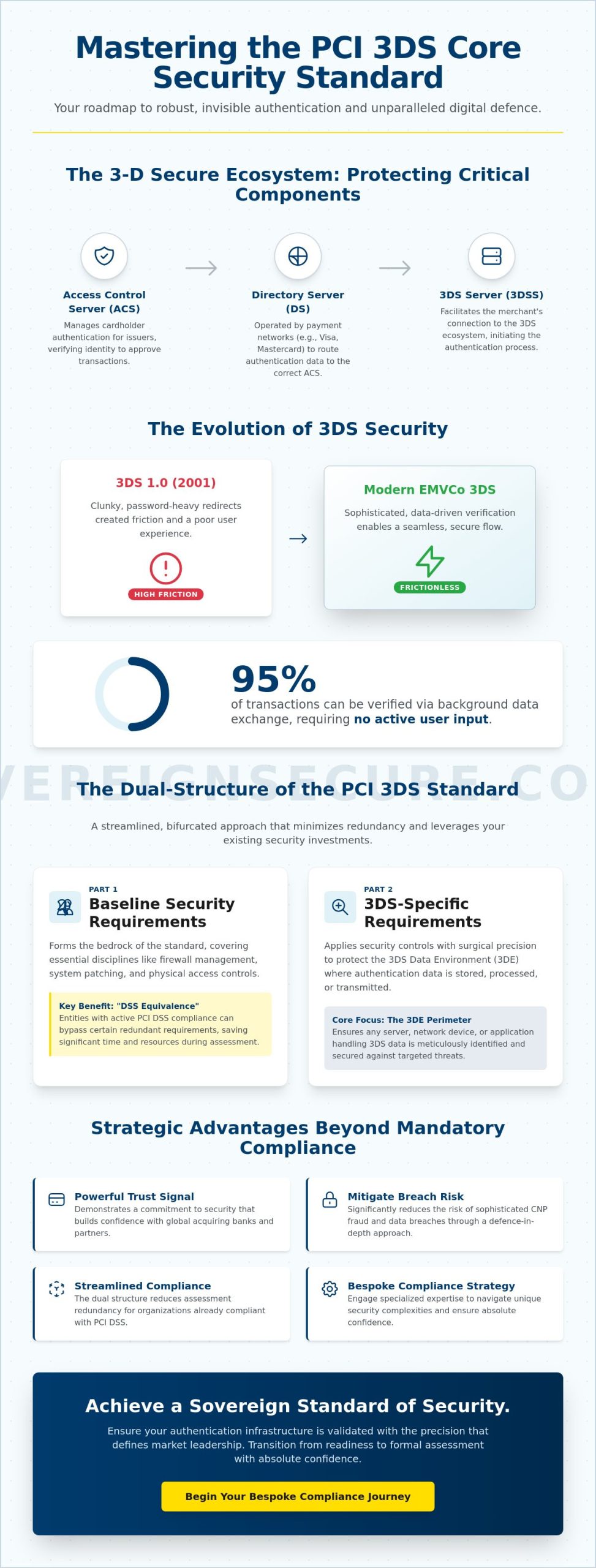
This standard focuses on protecting the primary functional components: the Access Control Server (ACS), the Directory Server (DS), and the 3DS Server (3DSS). While the 3DS Core Standard governs the server-side environment and data integrity, it’s distinct from the 3DS SDK Standard, which is specialised for securing the mobile application environment. As 2026 mandates for Strong Customer Authentication (SCA) become more rigid under evolving regional regulations, the rigour of these pci 3ds security assessments ensures that the underlying infrastructure can withstand sophisticated cyber threats while maintaining the fluidity of the user experience.
Who Requires a PCI 3DS Assessment?
The requirement for a formal assessment extends to any entity providing 3DS functions or hosting 3DS infrastructure. This includes 3DS Server providers who facilitate the merchant’s connection, Directory Server operators managed by payment networks, and Access Control Server providers who manage cardholder authentication for issuers. Third-party service providers that influence the security of these environments are also within the scope of these meticulous reviews.
Payment brands like Visa and Mastercard define their own validation programs, such as Visa Secure and Mastercard Identity Check. These brands often require annual onsite assessments by a specialised 3DS Assessor for high-volume service providers. Compliance is mandatory for those who wish to remain authorised participants in the global payment network; failure to validate can result in significant fines or the revocation of the ability to process authenticated transactions.
The Evolution of 3DS Security
The journey from the original 3DS 1.0, introduced in 2001, to the current EMVCo enhanced protocols represents a shift from clunky, password-heavy redirects to sophisticated, data-driven verification. PCI 3DS prevents fraud in the modern e-commerce ecosystem by establishing a secure, real-time data exchange between the merchant, the card issuer, and the payment network to verify the cardholder’s identity. This evolution prioritises frictionless authentication, where 95% of transactions can be verified through background data exchange without requiring active user input. The current standards provide the defence-in-depth necessary to support this seamless experience without compromising the security of the transaction data.
The Dual-Structure of the PCI 3DS Core Security Standard
The architecture of the PCI 3DS Core Security Standard is intentionally bifurcated to provide a streamlined path for entities already maintaining high levels of data integrity. This two-part structure minimises redundancy, allowing organisations to leverage existing investments in security infrastructure. By focusing specifically on the 3DS Data Environment (3DE), the standard ensures that both logical and physical security measures are applied with surgical precision. Achieving a successful outcome in pci 3ds security assessments begins with a meticulous identification of system components. Any server, network device, or application that stores, processes, or transmits 3DS data falls within the 3DE. Defining this perimeter with absolute accuracy is the first step in a comprehensive defence strategy.
Part 1: Baseline Security Requirements
Part 1 functions as the bedrock of the standard, covering essential security disciplines such as firewall management, system patching, and physical access restrictions. It recognises the maturity of modern security operations through the “DSS equivalence” rule. This provision allows firms with an active compliance status to bypass certain redundant evaluations, as the foundational requirements mirror those found in the broader Payment Card Industry Data Security Standard. If your team needs to revisit the fundamental principles of these controls, you can consult our detailed analysis of what is the pci dss to ensure your baseline is secure and ready for deeper evaluation.
Part 2: 3DS Specific Security Requirements
While Part 1 secures the environment, Part 2 secures the protocol. This section addresses the unique risks associated with the 3-D Secure ecosystem, placing heavy emphasis on Hardware Security Modules (HSMs) and sophisticated key management lifecycles. Because the protocol is built upon the EMV 3-D Secure specifications, the requirements here are highly specialised. They focus on maintaining message integrity and ensuring the authenticity of every transaction. Technical evaluation in this phase examines bespoke application security and logical controls that prevent unauthorised access to 3DS sensitive data during the authentication process. Ensuring these layers are correctly implemented provides an unrivalled level of protection for the transaction flow.
Navigating these technical intricacies requires a steady hand and deep expertise. To ensure your environment meets these elite standards without disruption, you might consider a bespoke security consultation tailored to your specific operational needs. Our approach prioritises discretion and precision, ensuring your pci 3ds security assessments are conducted with the thoroughness your reputation demands. We focus on the granular details so you can focus on your core business objectives with total peace of mind.
Strategic Advantages: Beyond Mandatory Compliance
Pursuing pci 3ds security assessments isn’t merely a box-ticking exercise for the risk-averse; it’s a statement of operational excellence. It signals to global acquiring banks and major card brands that an organisation manages the 3-D Secure infrastructure with surgical precision. While standard PCI DSS audits focus on the broader cardholder data environment, they often lack the granular focus required for the authentication path. Dedicated assessments ensure that the 3DS Server, Directory Server, or Access Control Server functions within a hardened perimeter, specifically mitigating the risk of credential stuffing and sophisticated man-in-the-middle attacks that target the 3DS protocol specifically.
Organisations often ask why their existing PCI DSS certification isn’t sufficient. The distinction lies in the technical architecture. 3DS environments handle the sensitive handshake between the merchant and the issuer, requiring unique cryptographic key management and message integrity checks. By conducting specialised pci 3ds security assessments, entities can identify vulnerabilities in the 3DS Requestor environment that standard audits might overlook. This meticulous approach facilitates a “frictionless flow,” where low-risk transactions are approved without active cardholder intervention. Data from 2024 indicates that merchants utilising optimised 3DS protocols see a 2% to 5% uplift in conversion rates compared to those relying on outdated or poorly configured authentication methods.
Enabling Strong Customer Authentication (SCA)
In the UK and EU, the regulatory landscape is defined by the strict requirements of PSD2 and the emerging PSD3 framework. Compliance with PCI 3DS standards aligns perfectly with these mandates, providing a robust technical foundation for Strong Customer Authentication. When a transaction is successfully authenticated via a compliant 3DS path, the liability for fraudulent “unauthorised” transactions typically shifts from the merchant to the card issuer. This protection is a critical financial safeguard. By future-proofing authentication strategies now, firms ensure they remain resilient against evolving payment regulations scheduled for 2025 and beyond.
Harmonising with Other PCI Standards
Sophisticated organisations don’t view security in isolation. Instead, they seek to align their 3DS strategy with broader pci security standards to create a unified defence posture. There are significant synergies when 3DS assessments are coordinated with pci p2pe security assessments, as both frameworks emphasise the encryption of sensitive data during transit. This holistic approach reduces audit fatigue by synchronising evidence collection and assessment schedules. For a deeper understanding of how these protocols interact, the PCI Security Standards document library provides the definitive technical blueprints for maintaining a secure and cohesive payment ecosystem.
The Path to Compliance: Readiness and Formal Assessment
Achieving a successful outcome in pci 3ds security assessments requires a meticulous, multi-phased approach that prioritises precision over speed. It’s a journey that transforms raw technical infrastructure into a validated, resilient environment. This process begins long before an authorised assessor arrives on-site, starting with a rigorous gap analysis to identify non-compliance issues that could jeopardise the formal audit. By addressing these discrepancies early, organisations avoid the reputational and financial risks associated with a failed submission.
Step 1: Scoping and Readiness
Defining the 3-D Secure Data Environment (3DE) boundaries is the most critical initial task. Over-scoping often leads to a 30% increase in unnecessary compliance costs, while under-scoping results in critical security gaps that lead to failure. By conducting a pre-assessment, organisations benchmark their existing controls against Part 2 requirements. This stage is particularly effective for identifying technical debt within legacy authentication systems. Addressing these architectural weaknesses ensures that the environment is robust enough to meet the 2024 standards for transaction integrity.
Step 2: Technical Evidence Collection
The burden of proof lies with the entity being assessed. This involves gathering extensive logs, configuration files, and detailed evidence of Hardware Security Module (HSM) management. It’s vital to distinguish between point-in-time evidence, which offers a mere snapshot of a control, and continuous evidence, which demonstrates that security measures remain effective throughout the entire 365-day cycle. For organisations that integrate PIN-based authentication within their 3DS flow, leveraging qualified pin assessor services dubai provides a specialised layer of expertise for managing complex cryptographic environments.
Step 3: Formal Validation and Attestation
During the formal phase, the authorised 3DS Assessor meticulously validates evidence and conducts interviews with key personnel to ensure policy matches practice. Once the assessor is satisfied, they produce the Reporting on Compliance (ROC) and the Attestation of Compliance (AOC). These documents are then submitted to relevant payment brands for final approval. Maintenance isn’t a static state; it requires annual re-assessments and quarterly vulnerability scans to ensure the integrity of the 3DE remains uncompromised. This disciplined cycle of pci 3ds security assessments ensures that your organisation maintains its standing within the global payment ecosystem.
Bespoke Compliance: The Sovereign Secure Approach to 3DS
Navigating the intricacies of pci 3ds security assessments requires more than a standard checklist; it demands a partnership built on absolute authority and total discretion. At Sovereign Secure, we operate with a philosophy of quiet confidence. We understand that for elite fintechs and global financial entities, security is a silent necessity rather than a public spectacle. Our approach is meticulously planned to ensure your operations remain fluid while your authentication infrastructure becomes impenetrable. We don’t rely on alarmist rhetoric. We rely on technical precision.
We provide a streamlined compliance experience by acting as a single, sophisticated partner for your entire security posture. Our assessors bring a wealth of technical expertise to the table, harmonising 3DS requirements with PCI DSS standards and our vulnerability scanning services. This unified methodology eliminates the friction of managing multiple vendors. It allows for a comprehensive view of your risk landscape that’s both thorough and efficient. By centralising these critical functions, we ensure that no gap in your defence goes unnoticed.
- Total discretion in all high-stakes assessments to protect your brand reputation.
- Meticulous planning that respects your operational uptime and business continuity.
- Technical expertise that translates complex mandates into clear, actionable strategies.
- A holistic view of security that integrates physical, digital, and intelligence-based protection.
Specialised Expertise for Global Fintechs
Our team has spent over 15 years operating within the high-pressure environments of the UK, Europe, and Asia. We’ve refined our “silent guardian” persona by protecting sensitive authentication data for organisations where failure isn’t an option. Since the 2022 shift in 3DS standards, we’ve guided over 100 high-growth entities through the complexities of multi-factor authentication and ACS environments. When technical issues arise, we don’t just identify them. We provide bespoke remediation advice that solves the root cause without disrupting your business flow. It’s about maintaining your momentum while fortifying your defence.
Securing Your Authentication Future
Choosing a partner for your pci 3ds security assessments is a decision that impacts your brand’s integrity and your customers’ trust. Sovereign Secure offers an unrivalled professional standard, ensuring that your compliance journey is handled with the weight and precision it deserves. We invite you to initiate a confidential consultation to discuss your specific requirements and experience the peace of mind that comes from true expertise. Our commitment to your privacy and protection is second to none.
Securing Your Position in the 2026 Compliance Landscape
Navigating the dual-structure standard requires more than a simple checklist. It demands a meticulous approach to data protection that aligns with the 2026 regulatory environment. Organisations that prioritise early preparation find that compliance serves as a powerful strategic asset rather than a mere administrative hurdle. Sovereign Secure facilitates this journey through our accredited status as a Qualified Security Assessor (QSA) holding the Specialised 3DS Assessor qualification. We combine a global presence with the refined precision of UK-based expertise to deliver a service that’s both comprehensive and discreet.
Our pci 3ds security assessments ensure your infrastructure meets the most rigorous international benchmarks while maintaining the absolute integrity of your transaction environment. This level of professional oversight transforms mandatory requirements into an unrivalled competitive advantage for your firm. We’re ready to provide the steady hand and technical authority required to navigate these high-stakes requirements with total confidence.
Request a Bespoke PCI 3DS Assessment Proposal
Frequently Asked Questions
What is the difference between PCI DSS and PCI 3DS?
PCI DSS secures general cardholder data across the entire payment ecosystem, while PCI 3DS specifically protects the infrastructure supporting the 3-D Secure protocol. The 3DS standard focuses on the messaging and authentication layers defined by the EMV 3-D Secure Core Functions Specification v2.3.1. It’s designed for entities like Access Control Servers and Directory Servers that facilitate the exchange of data between the merchant and the card issuer.
Who is required to undergo a PCI 3DS security assessment?
Entities performing specific 3DS functions, including Access Control Servers (ACS), Directory Servers (DS), and 3DS Server (3DSS) providers, must complete pci 3ds security assessments. This requirement primarily targets third-party service providers and financial institutions that manage these critical components. Payment brands like Visa and Mastercard mandate these audits to ensure the integrity of the 3-D Secure authentication process across their global networks.
Can my existing PCI DSS assessment satisfy Part 1 of the 3DS standard?
A valid PCI DSS Attestation of Compliance (AOC) can satisfy the baseline security requirements found in Part 1 of the 3DS standard. Your Qualified Security Assessor must verify that the 3DS environment was included in the scope of the original PCI DSS audit. This AOC must be dated within the last 12 months to be considered current and relevant for your 3DS compliance submission.
What components are included in the 3DS Data Environment (3DE)?
The 3DE encompasses all system components that process, store, or transmit 3DS data, such as Hardware Security Modules and databases containing 3DS Requestor IDs. It also includes systems that provide security services to the 3DE, including firewalls, multi-factor authentication servers, and logging systems. Every component within this perimeter is subject to rigorous testing during pci 3ds security assessments to ensure bespoke protection of the authentication pipeline.
How long does a typical PCI 3DS assessment take to complete?
A standard assessment generally spans 12 to 16 weeks from the initial gap analysis to the final submission of the Report on Compliance. This timeline includes 4 weeks for evidence collection and 2 weeks for the final quality assurance review by the auditing firm. Large organisations with complex, multi-layered infrastructures may require additional time to remediate findings before the final attestation is signed by the assessor.
What are the consequences of non-compliance with the 3DS standard?
Non-compliance often results in monthly fines ranging from $5,000 to $100,000, which are typically levied by the payment brands through your acquiring bank. Beyond financial penalties, an entity risks losing its status as a registered 3DS service provider. This suspension halts the ability to process 3-D Secure transactions, which can lead to a 100 percent loss of 3DS-related revenue until compliance is restored.
Is an on-site visit mandatory for a 3DS assessment in 2026?
The PCI Security Standards Council mandates on-site inspections for service providers to verify physical security controls within the 3DS environment. While remote testing was temporarily permitted during the 2020 pandemic, current regulations require physical access to data centres and secure rooms housing 3DS infrastructure. Assessors must visually confirm that hardware is protected and that access logs are maintained according to the strict 3DS physical security requirements.
Does PCI 3DS apply to mobile apps using 3DS SDKs?
PCI 3DS doesn’t apply to the mobile application itself, but it governs the 3DS SDK implementation and the backend 3DS Server it communicates with. App developers must ensure their SDK usage aligns with the EMVCo 3-D Secure SDK Specification to maintain the security of the transaction flow. The server-side components receiving data from the SDK are always within the scope of a formal security assessment.